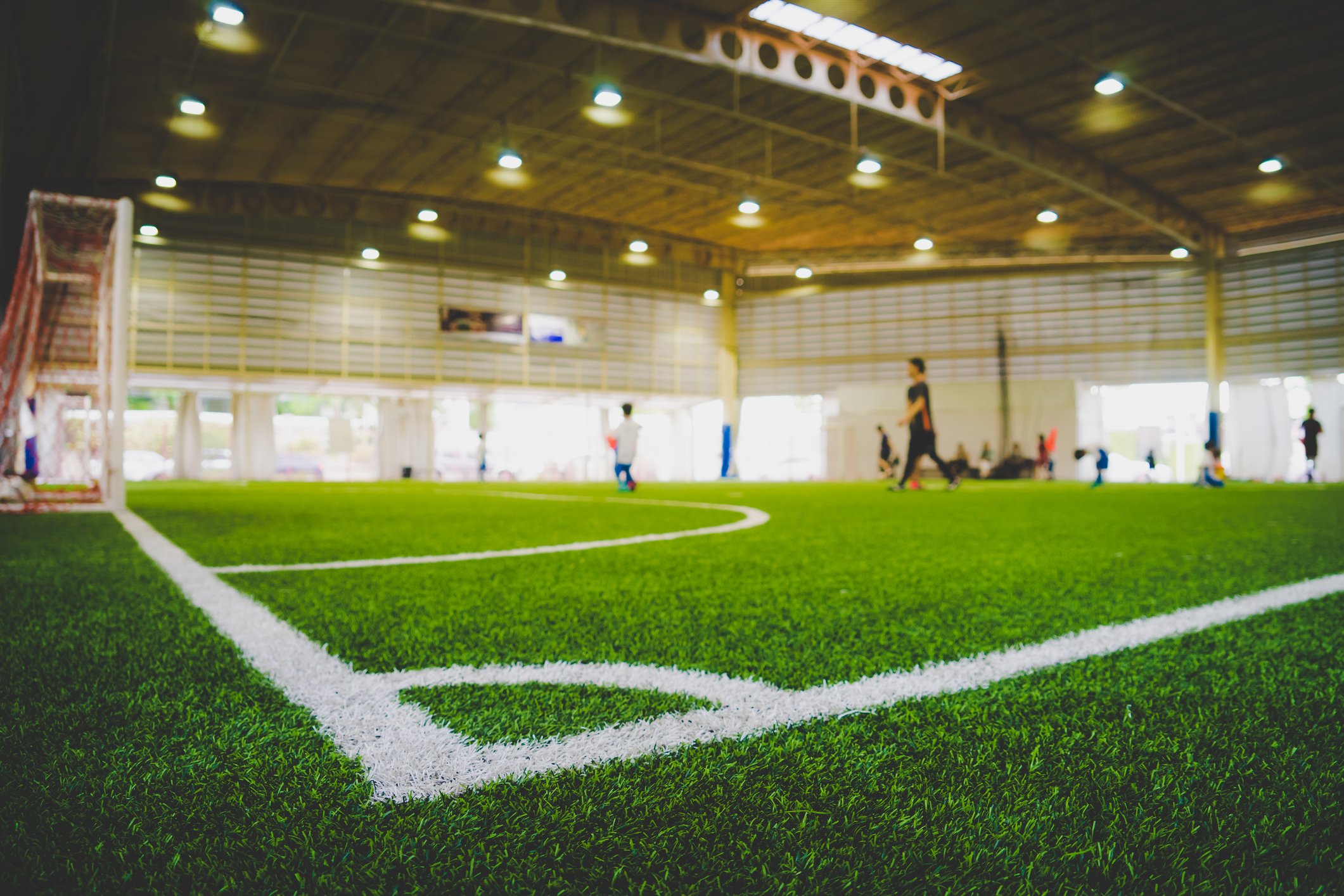
Across the country, communities, schools, and private operators are racing to build bigger, better indoor athletic facilities. From multi-court fieldhouses and elite training centers to year-round practice venues, today’s “mega-gyms” are engineered for scale.
From amenity-rich fitness facilities (some 100,000+ sq ft) to indoor practice facilities (some 300,000+ sq ft), these buildings are designed for consistent, all-weather training and peak performance. But they come with a fundamental challenge: how do you condition hundreds of thousands of square feet of interior space without creating crushing energy bills?
Traditional construction methods often struggle to meet the thermal demands of buildings of this size, especially when high ceilings dramatically increase air volume. As a result, architects and builders are turning to insulated metal panels (IMPs) as the solution.
Fast to install, thermally efficient, and structurally robust, IMPs deliver performance, speed, and long-term savings in a single integrated system, making them an increasingly obvious choice for facilities built to win.
The Rise of the Mega-Gym
Indoor sports facilities are no longer limited to a single basketball court or school gymnasium. Today's complexes often include multi-court basketball and volleyball setups, indoor soccer and turf fields, track facilities, strength and conditioning centers, indoor baseball and softball practice spaces, and event and tournament hosting areas.
These buildings must accommodate clear spans of 100 feet or more and ceiling heights that rival aircraft hangars. Steel framing makes those spans possible, but conditioning such enormous volumes of air has traditionally been expensive.
Without a high-performance building envelope, heating and cooling losses escalate quickly, and HVAC systems struggle to maintain comfort at floor level. This is precisely where IMPs change the game.
High R-Value: The Foundation of Efficiency
At the core of every insulated metal panel is a rigid foam insulation core sandwiched between durable metal facings, providing exceptional thermal resistance or R-value. Depending on thickness, IMP wall systems can reach R-values far exceeding those of conventional construction methods, helping buildings reduce heat transfer in both hot and cold climates.
In large facilities like sports complexes, that performance difference can translate directly into energy savings.
These buildings often feature tall ceilings and massive interior volumes, where warm air naturally rises. Without effective insulation, heat is easily lost through the roof or building envelope, driving up utility costs.
IMPs help maintain consistent indoor temperatures, minimizing energy waste and keeping operating budgets under control.
Continuous Insulation for Massive Volumes
Unlike traditional multi-component wall systems, IMPs provide continuous insulation across the entire surface. Tongue-and-groove joinery minimizes thermal breaks and air leakage, creating a highly efficient enclosure.
In practice, this means:
- Less temperature stratification.
- Reduced HVAC runtime.
- More uniform playing conditions.
- Improved indoor air quality.
For facilities that host tournaments or events, consistent climate control is not just a comfort issue, it is a competitive advantage.
Speed of Construction: Opening Day Comes Sooner
Time is money for sports construction. Projects are often tied to academic calendars, league seasons, or tournament schedules, and missing a completion deadline can mean lost revenue and disrupted programming.
Because IMP panels arrive factory-finished with insulation, vapor barrier, and exterior cladding integrated into a single component, installation is dramatically faster than traditional assemblies. Many systems can be installed year-round, allowing interior work to proceed shortly after erection. The result:
- Reduced labor costs.
- Shorter construction schedules.
- Earlier facility opening.
- Lower exposure to weather delays.
For growing communities eager to bring new sports infrastructure online, that speed can be decisive.
Lower Lifetime Operating Costs
Construction budgets often dominate decision-making, but for large athletic facilities, operating costs quickly surpass initial capital expenses. IMPs help reduce those long-term costs in several ways.
High insulation levels and airtight construction significantly lower heating and cooling loads, allowing facilities to maintain comfortable conditions with smaller or less frequently running mechanical systems.
The durable metal skins resist weather, impacts, and wear, reducing maintenance and repair costs over time.
And whether combating summer heat or winter cold, the panels resist thermal transfer year-round: keeping conditioned air inside where it belongs.
Comfort, Performance and Design
A well-designed sports complex is not just a building; it is an environment where performance happens.
Poor temperature control can affect athlete endurance and safety, equipment performance, spectator comfort, and scheduling flexibility. IMPs help create a stable indoor climate that supports year-round training and competition regardless of outdoor conditions.
Today's facilities are also often architectural landmarks, and IMPs support a wide range of aesthetics (bold colors, textured finishes, and contemporary profiles) allowing complexes to reflect team branding, institutional identity, or community character without sacrificing performance.
The panels' structural strength and lightweight nature also reduce demands on the supporting frame, contributing to overall construction efficiency.
Sustainability and Long-Term Value
Energy efficiency is no longer just a cost issue; it is increasingly tied to environmental goals and public expectations.
Buildings with high-performance envelopes consume less energy, produce fewer emissions, and are better positioned to meet modern sustainability standards.
For municipalities, universities, and private operators seeking LEED certification or other green benchmarks, IMPs can play a critical role.
A Smarter Envelope for Large-Scale Athletic Facilities
Designing and constructing modern sports complexes requires solutions that perform long after ribbon-cutting day.
Insulated metal panels provide a practical path forward, combining structure, insulation, air barrier, and exterior finish into a single integrated system that simplifies construction while delivering the thermal performance needed to control operating costs in large, open-span environments.
Green Span Profiles manufactures high-performance insulated metal panels engineered specifically for demanding commercial and institutional applications, including gymnasiums, indoor practice facilities, and multi-use athletic complexes. With a range of panel profiles, thicknesses, and finishes available, Green Span solutions support both architectural vision and building performance goals.
Whether planning a new mega-gym, expanding an existing campus, or developing a regional sports destination, partnering with Green Span Profiles means selecting a building envelope system designed to deliver efficiency, durability, and long-term value from day one.
Contact Green Span Profiles today to learn how our IMP systems can help your next athletic facility project stay on schedule, perform efficiently, and withstand decades of demanding use.