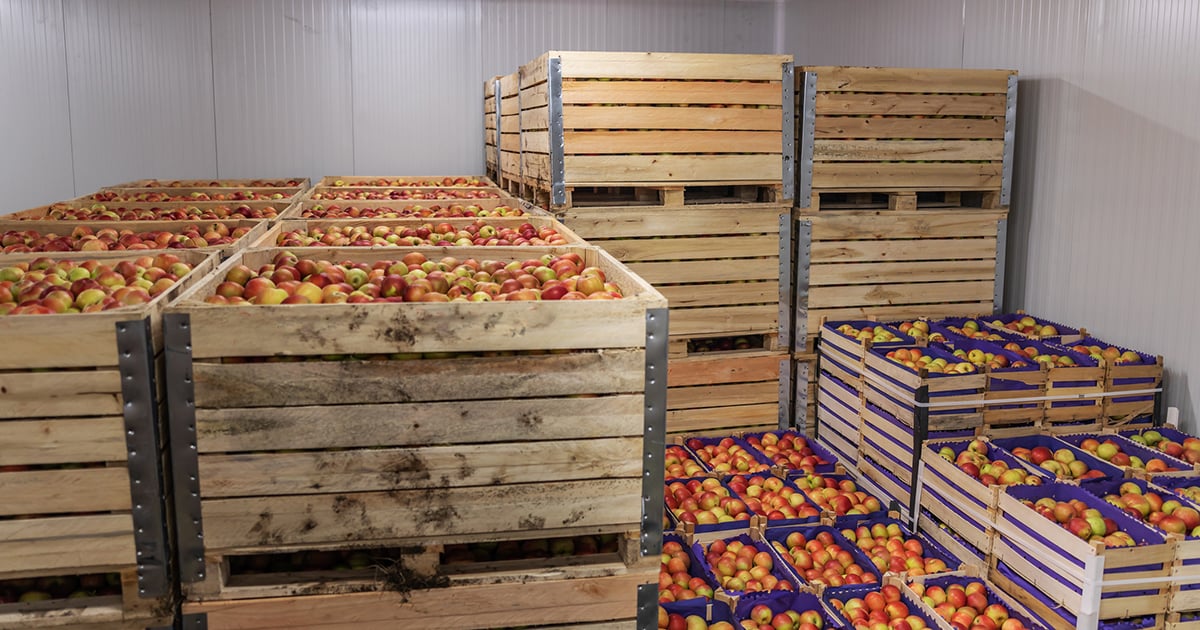
Cold storage is expensive to run and energy is the primary driver. With U.S. energy inflation rising 23.5% year-over-year as of May 2026, operators are facing an energy cost environment unlike anything seen in nearly four years.
Refrigerated warehouses already consume significantly more energy than standard facilities. According to the U.S. Energy Information Administration, they use roughly four times more energy per square foot. That difference is not driven by refrigeration equipment alone. It is heavily influenced by the building envelope. Every gap in insulation, thermal bridge or air infiltration point allows heat transfer that forces cooling systems to work harder.
Insulated metal panels (IMPs) are specifically engineered to address these challenges. For storage operators, improving the thermal performance of the building envelope with IMPs is one of the most direct and effective ways to reduce energy consumption and control long-term costs.
Energy Burden of Cold Storage
Before examining how IMPs reduce energy use, it helps to understand the scale of the challenge.
Industry estimates place monthly energy costs for cold-storage facilities between $0.50 and $1.25 per square foot, excluding demand charges, which can be significant for operations with large compressor loads. For a mid-sized refrigerated warehouse of 100,000 square feet, that can translate to hundreds of thousands of dollars annually just to maintain set temperatures.
Refrigeration equipment often receives the most attention when facility managers look for savings. However, the building envelope — including walls, roof, doors and panel joints — plays a critical role in determining how hard that equipment has to work. Poor insulation increases heat transfer, forcing refrigeration systems to run longer cycles, consume more electricity and experience greater wear over time. Improving insulation reduces system load, which lowers energy use and extends equipment lifespan.
Why R-Value Matters More in Cold Storage
R-value measures a material’s resistance to heat flow. The higher the R-value, the more effective the insulation. In a typical commercial building, the difference between R-13 and R-25 wall assemblies has a measurable but moderate impact on HVAC energy use. In cold environments, where the temperature differential between interior and exterior conditions can exceed 100° F, the impact of insulation performance is much more significant.
IMPs are particularly well-suited for these applications because of their polyisocyanurate (PIR) or polyurethane (PUR) foam cores, which provide high R-value per inch of thickness.
Typical R-values per inch for common insulation materials include:
|
Insulation Type |
R-Value Per Inch |
|
Fiberglass batt |
2.2 to 2.7 |
|
Mineral wool (rock wool) |
3.0 to 4.0 |
|
Expanded polystyrene (EPS) |
3.8 to 4.2 |
|
PUR foam (IMP core) |
6.0 to 7.2 |
|
PIR foam (IMP core) |
6.5 to 7.5 |
This performance gap is substantial. A 4-inch PIR-core IMP can achieve approximately R-26 to R-30, delivering similar thermal resistance to much thicker conventional wall assemblies.
For cold storage applications, IMP thicknesses commonly range from 4 to 6 inches, resulting in total R-values of roughly R-26 to R-45 depending on the panel type and core formulation. Green Span Profiles’ MesaLine IMPs, for example, have tested R-values in the R-44 to R-47 range at 6 inches of thickness, helping reduce refrigeration load over the life of the facility.
Continuous Insulation: The Structural Advantage
R-value tells only part of the story. In conventional wall assemblies, insulation is interrupted at studs, fasteners and other structural elements, creating what engineers call thermal bridging. These bridges conduct heat far more efficiently than the surrounding insulation, reducing real-world thermal performance well below the nominal R-value.
IMPs minimize this effect by providing a continuous layer of insulation across the panel face. Their concealed fastening systems also reduce the number of penetrations through the thermal barrier compared to traditional assemblies. As Metal Construction News has noted, IMPs provide “continuous insulation values and built-in thermal breaks” that conventional multi-layer systems cannot match.
This distinction is important in refrigerated warehouses, where even minor thermal bridges can create cold spots that lead to condensation, frost formation and, over time, potential material degradation. In addition to energy losses, these moisture-related issues can impact durability, maintenance requirements and long-term performance.
Air and Vapor Barrier Advantage
Energy loss in cold storage is not limited to heat transfer through walls. Air infiltration, particularly the entry of warm, humid outside air, increases refrigeration loads and creates conditions that can compromise both product quality and building performance.
Insulated metal panels address this by forming a tight, continuous envelope with integrated air and vapor control. The tongue-and-groove panel joints and concealed fastening system help limit air leakage and reduce pathways for moisture migration. As Metal Construction News notes, properly sealed IMP systems rely on effective vapor sealing to control moisture movement between cold interior spaces and warmer ambient conditions.
For refrigerated warehouses, this integrated approach allows the building envelope to serve multiple functions at once, including insulation, air barrier, vapor retarder and interior liner, within a single system. In contrast, conventional wall assemblies rely on multiple materials and trades to achieve similar performance, increasing the risk of gaps, inconsistencies and long-term infiltration at seams and penetrations.
What the Numbers Look Like
Named case studies with independently verified savings figures are relatively rare in published form because most data are proprietary to the operators involved. However, industry research does provide a clear picture of how energy-intensive cold storage can be and how much the building envelope matters.
According to industry research, refrigerated warehouses often consume 40 to 60 kWh of electricity per square foot annually, with refrigeration systems accounting for more than 70% of total facility energy use. By comparison, non-refrigerated warehouses typically use far less electricity per square foot, underscoring how much additional load is tied directly to maintaining low temperatures.
High-performance building envelopes, including IMP systems, help reduce heat gain and lower refrigeration loads by improving insulation, limiting thermal bridges and reducing air infiltration. While actual savings vary by climate, temperature setpoints, equipment efficiency and operating profiles, the trend in available data is consistent: facilities with higher-performing envelopes spend less on refrigeration energy over time.
Because every project has different conditions, operators evaluating an IMP-based cold-storage build or retrofit should work with design professionals to run project-specific energy models that account for local weather, envelope design and mechanical system performance. Those models can help quantify expected energy savings and payback periods, using the higher thermal performance of polyiso-core IMPs as a key lever in the overall efficiency strategy.
The following scenario illustrates the potential directional impact of envelope improvements on a mid-sized facility.
|
How Envelope Performance Affects Refrigeration Energy Use (Hypothetical) |
|||||
|
Scenario |
Annual electricity use (kWh/ft²) |
Refrigeration share of energy |
Annual kWh (100,000 ft²) |
Electricity rate (per kWh) |
Annual refrigeration energy cost |
|
Baseline: conventional envelope |
50 |
70% |
5,000,000 |
0.12 |
$420,000 |
|
Improved envelope with IMPs |
42 |
70% |
4,200,000 |
0.12 |
$352,800 |
|
Directional impact (IMP vs. baseline) |
–8 kWh/ft² (–16%) |
----- |
–800,000 |
------ |
–$67,200 |
Build a More Efficient Cold-Storage Facility
Refrigerated warehouse operators and their contractors have been specifying IMPs for cold-storage applications for decades. Metal Construction News has described IMPs as “the preferred method of construction for buildings in which refrigerated or other low temperature-controlled interior environments are required,” citing their insulating value per inch and integrated barrier performance as key factors.
For new facilities, IMPs help reduce the capital cost of refrigeration systems by lowering the thermal load those systems need to handle. For existing facilities looking to reduce energy spend, IMP retrofits offer a path to meaningful envelope improvement without a full rebuild.
Green Span Profiles manufactures IMPs engineered for the performance requirements of cold-storage and refrigerated warehouse construction. Our panel systems deliver high R-values, continuous insulation and integrated air and vapor barrier performance to reduce energy costs and support reliable temperature control over the life of the facility.
Contact Green Span Profiles to discuss your cold-storage project